

Last updated: October 2026
Surgical tech skills at a glance
| Skill | Type | Why it matters in the OR |
|---|---|---|
| Sterile technique and attention to detail | Technical | Prevents surgical site infections |
| Instrument recognition and handling | Technical | The right instrument, instantly |
| Anatomy and medical terminology | Technical | Follow the procedure and the team |
| Infection control | Technical | Sterilization, asepsis, safe handling of contaminated items |
| Dexterity and hand-eye coordination | Technical | Pass, load and hold without slips |
| Equipment and technology | Technical | Electrosurgical units, scopes, robotic systems |
| Communication and teamwork | Soft | Speak up clearly without breaking the sterile field |
| Anticipation | Soft | Stay one step ahead of the surgeon |
| Problem-solving and adaptability | Soft | Cases change; you adjust |
| Stress management | Soft | Stay steady in emergencies |
| Organization and time management | Soft | Trays ready, counts right, cases on time |
| Physical stamina | Soft | Hours on your feet, often in one position |
| Ethics and professionalism | Soft | Patient privacy and trust |
| Continuous learning | Soft | New procedures and equipment every year |
Technical skills every surgical tech needs
These are the hard skills you build in training and sharpen with every case. You can't fake your way through them.
1. Sterile technique and attention to detail
Sterile technique is the foundation of everything you'll do. Every instrument, piece of equipment and supply has to be prepared accurately and to sterile protocol, and a small oversight can lead to infection or complications for the patient. Keeping a sterile environment takes meticulous attention in handling instruments, gowning, gloving and setting up the surgical field. You're the person who spots the contaminated glove before anyone touches it, and who calls out the break in technique that could lead to a surgical site infection.
2. Instrument recognition and handling
You need to know hundreds of instruments by sight and feel, what each one does, and how to arrange them for different procedures. With practice this becomes muscle memory: you load a needle driver or hand over the right retractor without having to think about it.
3. Anatomy and medical terminology
A solid foundation in anatomy and medical terminology is indispensable. Knowing the structure and function of the body lets you anticipate the surgeon's needs, helps with patient positioning and exposure, and helps you spot potential complications. When you're across the table from a surgeon doing a bowel resection, you need to know which structures are where and why that matters for instrument placement. Terminology keeps communication with the team clear and cuts the risk of misunderstandings and mistakes.
4. Infection control
Preventing infection is paramount in surgery. Surgical technologists need to know infection control protocols well: sterilization methods, aseptic procedures and the proper handling of contaminated materials and specimens.
5. Dexterity and hand-eye coordination
You work with delicate instruments that need precise handling. Steady hands and good hand-eye coordination matter for passing instruments, loading needles, holding retractors and cutting sutures, and they help prevent accidental injuries to the patient and the team. O*NET lists arm-hand steadiness, manual dexterity and near vision among the top abilities for the job (O*NET).
6. Equipment and technology
Surgical technologists work with a range of equipment, including diagnostic tools, imaging devices and robotic systems, and must understand how to operate and troubleshoot them. When the electrosurgical unit starts acting up mid-procedure, you need a solution in seconds, not minutes. Keeping up with new medical technology is part of giving patients the best possible care.
Soft skills that make a great surgical tech
These are the skills a program may mention once at orientation before going back to instrument counts. They matter more than anyone admits upfront.
7. Communication and teamwork
Surgery depends on seamless collaboration. You communicate with surgeons, nurses, anesthesiologists and other team members who often outrank you, but when you spot a problem you have to speak up clearly and immediately. Good techs balance being assertive about patient safety with being respectful of team dynamics, and strong teamwork means anticipating what the surgeon and the rest of the team will need.
8. Anticipation
Watch an experienced surgical tech and you'll notice they're always one step ahead. Before the surgeon asks for the next instrument, it's already in position. Before the nurse needs another sponge, it's counted and ready. That's pattern recognition, built from experience and active observation.
9. Problem-solving and adaptability
Not every surgery goes to plan. The patient's condition can change suddenly, or equipment can fail. Being adaptable and quick-thinking keeps the room calm and efficient when that happens.
10. Stress management
The operating room can be high-stress, especially in complex or emergency surgery: a trauma case where the patient is bleeding, an emergency C-section where seconds matter, or complications that cascade faster than anyone expected. You need to manage stress and emotion so you can keep working with focus and composure, because the patient depends on the team working well under pressure.
11. Organization and time management
Operating rooms run several tasks at once. Your morning might start with three scheduled surgeries; then an emergency trauma comes in, and the afternoon's orthopedic case runs long. Being organized, from preparing the tray to anticipating the next move, and prioritizing well across the whole day decides how smoothly the cases go.
12. Physical stamina
You need to be comfortable standing for long periods (BLS). Picture standing in one spot for hours in heavy lead in a cardiac cath lab, holding your posture so you don't contaminate anything, and staying sharp enough to catch every detail.
13. Ethics and professionalism
Surgical technologists see sensitive patient information and take part in critical procedures. Integrity, professional behavior and respect for patient privacy are essential to the trust patients and teams place in you.
14. Continuous learning
Healthcare keeps changing. New surgical techniques appear, robotic systems update their software and instrument makers redesign their tools. Professional development and continuing education are part of the job, and certifications require them to stay current.
The skills you build on the job
Your certification gets you in the door. Some things you can only learn by doing, which is why your first year matters so much:
- Time management in controlled chaos: handling the schedule when emergencies and long cases collide, and keeping quality up across all of it.
- Emotional resilience: you will see hard things, including patients who don't survive and children with serious injuries. Techs who last build coping habits and boundaries that protect their mental health while keeping their empathy.
- Learning as a habit: if you aren't investing in continuing education, you're falling behind.
Many techs go on to specialize, for example in cardiovascular, orthopedic or neurosurgical cases. See the surgical tech career path.
What the BLS and O*NET say employers look for
The U.S. Bureau of Labor Statistics lists seven important qualities for surgical technologists (BLS):
- Communication: relaying issues during surgery to the rest of the team to prevent infections or other complications.
- Detail oriented: for example, giving surgeons the correct sterile equipment.
- Dexterity: working with your hands and supplying equipment quickly.
- Integrity: being ethical and honest, because the team trusts you during surgery.
- Listening skills: understanding spoken directions from surgeons and other team members.
- Physical stamina: standing for long periods.
- Stress-management skills: working well under pressure.
O*NET's profile for surgical technologists (updated October 2026) lists the work styles employers value most as stress tolerance, self-control, cooperation, cautiousness, integrity, attention to detail and dependability, and the core skills as monitoring, active listening, reading comprehension, speaking, active learning and critical thinking (O*NET).
Skills by work setting
Most surgical technologists work in hospitals; see where surgical techs work for the full breakdown. Each setting leans on different skills:
| Setting | Skills that matter most |
|---|---|
| Hospital operating rooms | Sterile technique, stamina, composure, communication (every type of case, including on-call and emergencies) |
| Ambulatory surgery centers | Versatility, speed and organization across many short same-day cases |
| Emergency teams | Quick decisions, readiness for the unexpected, teamwork |
| Labor and delivery units | Sterile setup under time pressure, calm with families present |
| Private surgical practices | Deep knowledge of one specialty's procedures and instruments |
| Dental and oral surgery offices | Instrument handling and patient care in a small team |
Surgical tech skills for your resume
Hiring managers scan for proof, not adjectives. On your resume, pair skills with evidence:
- Credential: your certification (CST, TS-C or NRST) and BLS/CPR.
- Case experience: total cases, first-scrub cases and specialties, for example "125 cases, 90 as first scrub, across general, orthopedic and OB/GYN".
- Technical skills: sterile technique, instrument setup and counts, specimen handling, electrosurgical and laparoscopic equipment, robotic systems if you've used them.
- Soft skills, with an example: "kept counts accurate across back-to-back trauma cases" says more than "works well under pressure".
- Software: electronic medical records (EMR) such as MEDITECH, which O*NET lists among the job's technology skills.
A simple skills checklist works too: list the technical skills from this page and tick the ones you can show with a case or a reference. Our certification guide explains which credential to aim for.
How to build your surgical tech skill set
Start with proper training. A program teaches the technical foundation, clinical cases give you the hands-on practice, and certification shows employers you meet a national standard. See how to become a surgical tech for the steps and how externships and clinical cases work. Before you choose a program, our free surgical tech practice exam shows where your knowledge stands.
Prepare for the NRST Exam Online
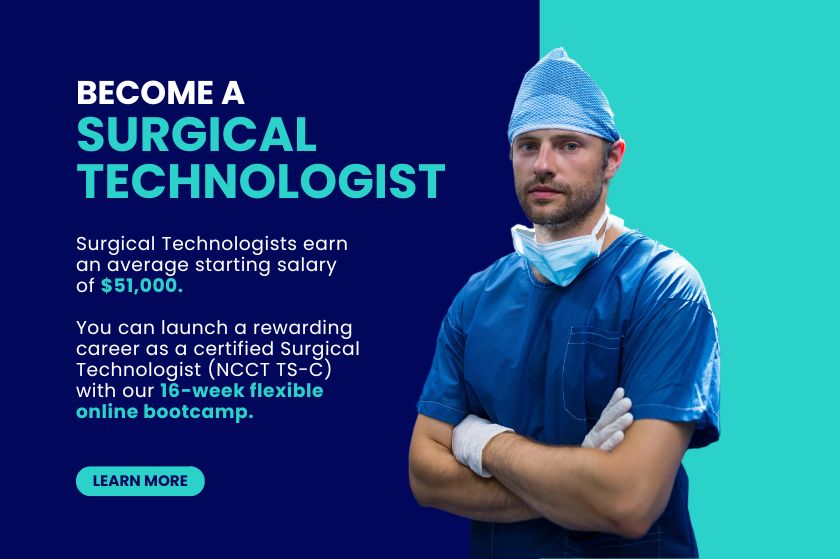
Our online Surgical Technologist program is 16 weeks, self-paced and 260 hours, and prepares you for the NRST exam from American Allied Health, with one exam voucher and five 1-on-1 coaching sessions included. It's coursework only, with no clinical requirement. If you want documented operating room cases, the Surgical Tech Professional program prepares you for the NCCT TS-C and adds 125 cases at a clinical facility.
See the Surgical Technologist Program →Comparing cost and time with a community college or online college? See how the main surgical tech training routes compare.
Hear from One of Our Surgical Tech Students
A dose of reality
This job isn't for everyone, and that's fine. If you can't handle blood, need frequent breaks, shut down under pressure or struggle in hierarchical teams, it may not be your calling. If you find satisfaction in precision work and like being the person who makes everything run smoothly behind the scenes, it can be a rewarding career.
- Surgical technologists earned a median of $64,650 a year in May 2025, with room to grow as you specialize (BLS).
- Employment of surgical assistants and technologists is projected to grow 5% from 2025 to 2035, with about 8,600 openings a year.
A career in surgical technology takes a rare blend of technical skill, medical knowledge and personal qualities. Start with the technical foundation, don't neglect the soft skills, and keep pushing past your comfort zone. Every expert surgical tech once stood where you are, wondering if they had what it takes. For the pros and cons in full, see is surgical tech a good career?
Frequently asked questions
What skills do you need to be a surgical tech?
Technical skills such as sterile technique, instrument knowledge, anatomy and terminology, infection control and dexterity, plus soft skills such as communication, teamwork, anticipation, problem-solving, stress management, organization and physical stamina.
What is the most important skill for a surgical tech to master first?
Sterile technique. You can improve your speed, communication and anticipation over time, but if you can't maintain a sterile field you're a risk in the OR. Everything else builds on it.
What are soft skills for a surgical tech?
Communication, teamwork, anticipation, adaptability, composure under pressure, organization, integrity and emotional resilience. They decide how well you work with the surgical team, especially when a case gets difficult.
What does a surgical technologist do?
A surgical technologist helps surgeons and nurses during operations: preparing the operating room, sterilizing and arranging instruments, passing tools and keeping the sterile field. See what a surgical tech does.
Where do surgical technologists work?
Mostly in hospitals (71% in 2025, according to the BLS), plus outpatient surgery centers, physicians' offices and other settings. See where surgical techs work for the full breakdown.
What skills should I put on a surgical tech resume?
Your certification and BLS/CPR, your case numbers and specialties, technical skills such as sterile technique, instrument setup, counts and specimen handling, and soft skills backed by a short example.
How long does it take to feel confident as a surgical tech?
It builds case by case. The first year is usually the steepest, and feeling overwhelmed early on is normal. Confidence grows as you see the same procedures and surgeons again and again.
Can I specialize in one type of surgery?
Yes. Many techs specialize once they have solid general OR experience, most often in cardiovascular, neurosurgery or orthopedics. You get less variety, but you become an expert in that specialty's procedures and instruments.
Do I need to be good at math to be a surgical tech?
Basic math is enough: counting instruments and sponges, occasional medication measurements and inventory. The harder part is staying accurate when you're tired, stressed or juggling several tasks.
What if I'm good at the technical skills but struggle with the soft skills?
Work on them deliberately, the same way you learned instrument names. Communication, teamwork and resilience can be developed. Ask experienced techs and surgeons for feedback, watch how strong team members interact, and look for communication training for OR staff.
How can I start a career as a surgical technologist?
Complete a surgical technology program, pass a national certification exam and apply for jobs. Our online Surgical Technologist program covers the coursework in 16 weeks; the Surgical Tech Professional program adds in-person surgical cases. See how to become a surgical tech.